Summary
- We're not here to sell you peptides. We're here to find out why you don't feel like yourself, and that may involve hormones, thyroid, insulin, inflammation, sleep or several together.
- Peptide therapy uses short chains of amino acids to signal your cells. More than 80 peptide medicines are approved worldwide, from insulin to GLP-1s like semaglutide.
- A peptide is a signal, and your body decides what happens next. Insulin resistance, poor sleep, inflammation and hormone levels change how well a peptide works, which is why we start with 160+ biomarkers.
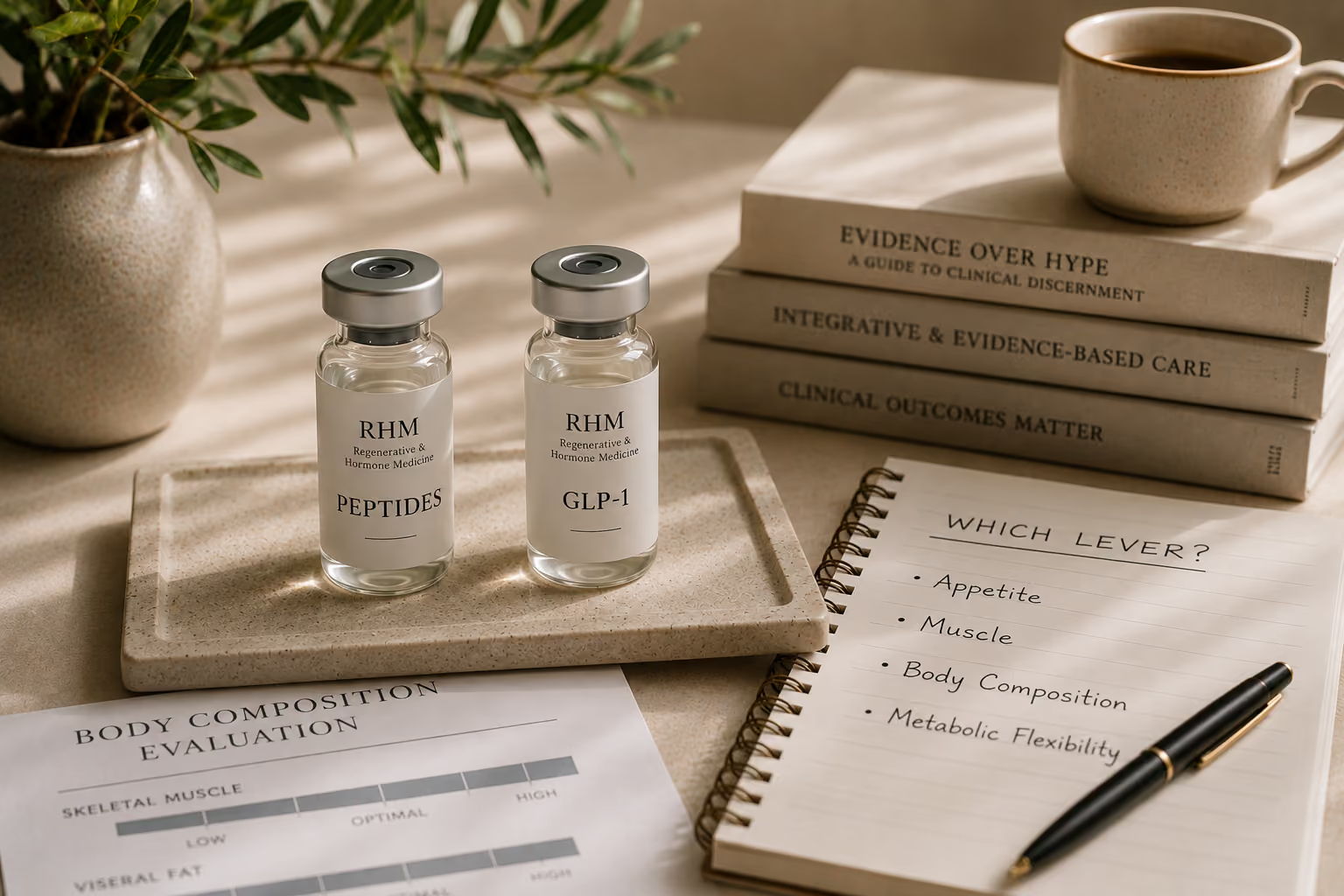
- The strongest evidence is metabolic. Peptides can support insulin sensitivity, muscle preservation, body composition and metabolic flexibility. Evidence for recovery, sleep and skin varies by peptide.
- Approval varies. Semaglutide, tirzepatide, tesamorelin and bremelanotide are FDA-approved for specific uses. BPC-157 isn't, and its compounding status is still being decided in 2026.
- Where it comes from matters. "Research use only" peptides sold online have no checks on purity, dose or sterility.
- Care starts with a VIP call. It's the first step to becoming an RHM patient: a full evaluation, a physician-built plan and monitoring as your body responds.
You used to bounce back. A hard workout left you sore for a day. Your energy lasted into the evening, and the effort you put in showed up in the mirror. Now you're doing as much as ever, maybe more, and your body has stopped answering. Maybe you've asked about it and heard that your labs are fine, or that this is just what your forties feel like.
And it shows up everywhere. You cut workouts short because you already know how tomorrow will feel. You skip the photo and avoid the mirror. By eight o'clock you have nothing left for your partner or your kids, and the things you used to look forward to have become one more thing to get through. Being tired is the symptom. What it's costing you is the reason to look closer.
So you started reading about peptides. A friend swears by one, your feed is full of before-and-after photos, and someone at the gym told you exactly what to order. Every source names a different peptide, and none of them asked what's actually going on in your body. You want something that works, from someone who can explain why.
We're Not Here to Sell You Peptides
Most pages about peptide therapy are written by someone selling peptides, so the question they answer is which one to buy.
We're not here to convince you that you need peptides. We're here to figure out why you don't feel like yourself anymore.
Sometimes a peptide is part of the answer. Often what's driving the fatigue, the stubborn weight or the slow recovery sits in your hormones, thyroid, insulin and metabolism, inflammation, sleep or nutrient status, and those systems talk to each other. A peptide works best when it's chosen for the system that needs support, at a time when your body can respond to it.
Why This Keeps Getting Missed
You've probably been handed a separate answer for each symptom. Poor recovery? Rest more. Weight that won't move? Eat less, train harder. Low energy? Coffee. Restless sleep? Stress.
What if they're connected? Slow recovery, weight gain around the middle, poor sleep and fading drive often travel together because they share the same physiology. If your body has stopped responding to the effort you put in, this is physiology, not personal failure. This usually comes down to how care is set up: a short appointment is built to rule out disease, and an online peptide order is built to ship a vial. Neither is designed to look at the whole picture.
"Your Labs Look Normal." Which Labs?
A routine panel often leaves out hormones, checks thyroid with a single value and reads every result against a population average. "In range" isn't the same as optimal. Normal is an average. You are not an average.
At RHM, we read 160+ biomarkers across hormones, thyroid, insulin and glucose, inflammation, nutrients and more, and we read them alongside how you actually feel. Before anyone talks about a peptide, we want to know what your body is doing.
If this sounds like you, a VIP call is where care with RHM begins. We'll talk through what's changed, what you've tried and what you want to feel like again, then map out the evaluation that finds what's driving it. Book a VIP call.
A Peptide Is a Signal. Your Body Decides What Happens Next.
If you've tried something that worked for a friend and did nothing for you, this is usually why.
Peptides work by binding to receptors on your cells and passing along an instruction: release a hormone, repair tissue, slow digestion, change how hungry you feel. The instruction is only half of it. The other half is the body receiving it.
Someone with insulin resistance, short sleep or a chronically inflamed system can take the same peptide as someone without them and get a very different result. A growth-hormone-releasing peptide depends on a pituitary that can respond and on blood sugar that can tolerate the change. A recovery peptide works on tissue that's also shaped by your hormones, your sleep and how much inflammation you carry.
That's the thread through everything below. Peptides can be useful, and the body you bring to them decides how useful. It's why we start with your labs.
What Is Peptide Therapy?
If peptides sound new, you already know a few.
Peptide therapy uses peptides, short chains of amino acids, to send specific signals to cells: to release a hormone, repair tissue, regulate appetite or calm inflammation. Some are FDA-approved medicines, such as insulin and GLP-1 drugs like semaglutide. Others are newer and still being studied.
Peptides are smaller than proteins, usually between two and fifty amino acids, which lets them act as precise messengers. Your body makes thousands of its own, including insulin, oxytocin and the hormones that control appetite. Therapeutic peptides are made to copy or adjust those signals. They're also well-established medicine: more than 80 peptide drugs have been approved worldwide, according to a 2022 review in Signal Transduction and Targeted Therapy.
That history is easy to lose in the online hype, and it matters. "Peptide" describes a type of molecule. It says nothing about quality: a carefully studied, FDA-approved peptide and an unregulated vial labeled "for research use only" are both peptides.
How Peptide Therapy Works: Injections and Other Forms
Most people's first question is whether peptides have to be injected. Usually, yes, and here's why.
Your digestive system breaks peptides down the same way it breaks down protein from food, so most therapeutic peptides never reach the bloodstream intact if you swallow them. That's why most peptide treatments are given as a small injection under the skin (subcutaneous), much like insulin, with a short, thin needle.
- Subcutaneous injection is the most common route, used for GLP-1 medications, growth-hormone-releasing peptides and most recovery peptides.
- Oral forms exist for a few peptides, such as oral semaglutide, which is built with an ingredient that helps it survive digestion.
- Nasal sprays, lozenges and creams are used for some peptides, though absorption varies a lot from one product to the next.
Collagen powders and "peptide" supplements are different. They're digested like food protein and aren't the same as prescription peptide therapy.
Types of Peptides and What They're Used For
This is where the online noise is loudest, so we've grouped the peptides people ask us about most by what they're used for and how firm the evidence is. "Explored for" means early research or clinical use, not proven benefit. If anyone recommends a peptide before looking at your labs, it's fair to ask what they're basing that choice on.
Metabolic health and weight
- Semaglutide and tirzepatide are FDA-approved for type 2 diabetes and weight management. They're the most thoroughly studied peptides on this list. Read more about semaglutide and tirzepatide.
Growth-hormone signaling
- Tesamorelin is FDA-approved to reduce excess abdominal fat in adults with HIV-associated lipodystrophy, and is explored more widely for visceral fat and body composition.
- Sermorelin was once FDA-approved for children with growth hormone deficiency. The manufacturer stopped making it in 2008 for business reasons, not safety or effectiveness, and it's now available through compounding pharmacies.
- CJC-1295 with ipamorelin is explored for sleep, recovery and lean body composition. It isn't FDA-approved, and human data is limited.
Recovery and tissue repair
- BPC-157 and TB-500 (a fragment of thymosin beta-4) are explored for tendon, ligament and soft-tissue healing. Most of the evidence comes from animal studies, and neither is FDA-approved.
Skin and hair
- GHK-Cu, a copper peptide, has the strongest evidence as a topical ingredient for skin. Injectable use is less studied.
Sexual health
- PT-141 (bremelanotide) is FDA-approved as Vyleesi for low sexual desire in premenopausal women and is used off-label in other situations. Low desire has many possible drivers, from hormones to sleep to medications, so it deserves a full look first. Our sexual health care starts there.
What else it can be: slow recovery, stubborn belly fat and poor sleep can all trace back to low testosterone or estrogen, thyroid function, insulin resistance or short sleep. A peptide may help, but it won't correct a driver nobody has measured.
A list like this shows you what exists. Which system in your body needs support, whether a peptide is the right tool for it and what dose your physiology can handle are questions only your labs and your history can answer. Working through them with you is what RHM's physicians do.
Peptide Therapy Benefits: What the Evidence Supports
You want to know what you could realistically expect. The answer depends on the peptide, the goal and the starting point, and the evidence is strongest in four areas that affect almost everyone after 35.
- Insulin resistance. GLP-1 peptides improve how your body handles glucose and insulin, which is why they started as diabetes medicines. Insulin resistance often comes before weight gain, fatigue and cravings, and it can be present even when fasting glucose looks normal. Our insulin resistance testing shows where you stand.
- Muscle preservation. In the STEP 1 trial of semaglutide, participants lost about 15% of their body weight, and body scans in a subgroup showed lean mass fell by about 9.7%. Losing weight without protecting muscle can leave you lighter but weaker, with a slower metabolism. This is where supervision earns its keep: protein targets, strength training and, for some people, growth-hormone signaling help you keep the muscle you've built.
- Body composition. The goal is a better ratio of muscle to fat, especially less visceral fat around your organs. Tesamorelin's approval rests on that measurement: it reduced abdominal fat on CT scans.
- Metabolic flexibility. A healthy metabolism switches easily between burning glucose and burning fat. Insulin resistance, poor sleep and low muscle mass make that switch sluggish. Peptides that improve insulin sensitivity or protect muscle can help restore it, especially alongside the right nutrition and training. Metabolic testing measures where you're starting from.
What else it can be: if the scale is moving but you don't feel stronger, or your sleep hasn't improved, look at what sits underneath: testosterone or estrogen, stress and cortisol, iron and vitamin D, or untreated sleep apnea. They show up in a thorough evaluation, and they change which peptide makes sense, or whether you need one at all.
Beyond those four, peptides are used for recovery, sleep quality, skin and sexual health. The evidence there ranges from FDA approval for one specific use to early animal research. A good plan is clear about which is which.
Are Peptides FDA Approved? Are They Legal?
If you've searched this and come away more confused, you're not alone. It depends on the peptide and where it comes from, and peptides fall into three groups.
- FDA-approved peptide drugs. Semaglutide, tirzepatide, tesamorelin, bremelanotide and insulin went through clinical trials for a specific use and are made to pharmaceutical standards. A doctor can prescribe them for that use, or off-label when there's good reason.
- Compounded peptides. Licensed compounding pharmacies can prepare some peptides from a prescription, under federal rules on which ingredients they may use. For peptides like BPC-157, those rules are changing: the FDA removed it from its restricted list in April 2026, and in July 2026 an FDA advisory committee voted 8–6 to recommend allowing it for compounding. That recommendation isn't final, and the FDA's own reviewers questioned how much human evidence exists.
- "Research use only" peptides. These are sold online for laboratory use, not for people. Nobody checks their purity, dose or sterility. A vial labeled BPC-157 may contain less, more or something else entirely.
If you're offered a peptide at a price that seems too good, ask where it comes from and whether a licensed pharmacy dispensed it.
If you compete in sport, check the rules first. BPC-157 is on the World Anti-Doping Agency's prohibited list, along with many growth-hormone-releasing peptides.
Before You Buy Peptides Online, Ask What You're Actually Getting
Ordering a peptide online can feel like taking charge of your health. Before you do, a few questions are worth asking:
- Do you know what's in the vial? Is it an FDA-approved drug, prescribed and dispensed by a pharmacy? Or is it a research chemical with no independent testing?
- Is anyone asking why? A peptide can be chosen in two minutes. Understanding why your recovery slowed or your weight shifted takes a full evaluation.
- What happens if it doesn't work? Three months in, if you're still tired and still stuck, will anyone look further, or will you be sold the next peptide?
- Who's watching your labs? Growth-hormone-releasing peptides can raise IGF-1 and blood sugar. Someone should be checking both.
- Who do you call if something feels off? If you react badly or your symptoms change, is there a physician who knows your history?
A low price on the vial can leave out the parts that make treatment safe and effective: the evaluation, the monitoring and the adjustments along the way.
Side Effects, and Who Should Be Careful
It's reasonable to want to know what could go wrong before you start. Most side effects are mild, and they depend on the peptide.
- Injection-site reactions, such as redness, itching or a small bump, are the most common across peptides.
- GLP-1 peptides often cause nausea, fullness, constipation or diarrhea, especially as the dose goes up.
- Growth-hormone-releasing peptides can cause water retention, tingling, headaches and higher blood sugar, and they raise IGF-1.
- Bremelanotide commonly causes nausea and flushing and can briefly raise blood pressure.
- Newer peptides like BPC-157 have very little human safety data, which means the long-term risks are unknown.
Some people should avoid certain peptides or use them only with close supervision. That includes anyone who is pregnant, breastfeeding or trying to conceive, anyone with active cancer or a history of certain cancers (especially for peptides that stimulate growth hormone), and people with poorly controlled diabetes, heart disease or kidney disease. If you feel "off" after starting a peptide, tell your prescriber right away. It's often the dose, the timing or a sign that something needs a closer look.
What else it can be: feeling worse after starting a peptide sometimes has more to do with what was already going on. Blood sugar swings, poor sleep or a hormone that was already low can make side effects feel bigger and results feel smaller, which is one more reason to start from your labs.
Peptides, GLP-1s, TRT and HRT: How They Fit Together
Maybe you're already on testosterone or hormone therapy, or comparing your options. These treatments can work together, and they act on different systems.
GLP-1 medications are one well-studied family of peptides, focused on appetite, blood sugar and weight. Other peptides target growth-hormone signaling, recovery or sexual health. Our comparison of peptides vs GLP-1s goes deeper. Testosterone and estrogen therapy replace a hormone that's low. Peptides usually prompt your body to change its own signaling. For some people the right plan includes both. We compare the two directly in peptide therapy vs TRT.
You may also have heard about GLP-1 microdosing, which means taking much smaller doses than the studied amounts for energy, inflammation or appetite. It's popular, and it's barely studied. There are no established doses or reliable data on results, so it belongs in a conversation with a physician who knows your labs.
How RHM Does Things Differently
Peptide therapy at RHM starts with your physiology.

- A discovery call about what's changed, what you've tried and what you want to feel like again.
- A comprehensive evaluation of 160+ biomarkers across hormones, thyroid, insulin and glucose, inflammation and nutrients, read together with your symptoms.
- Physician review. If a peptide fits, we choose it for the system that needs support. If the answer is sleep, thyroid, insulin or hormones first, we'll tell you.
- A personalized plan with clear expectations for each goal. Appetite changes on GLP-1s can start within weeks, while body composition, sleep and recovery usually take a few months to show.
- Ongoing monitoring of your labs and how you feel, so the plan changes as you do.
Many people come to us asking about a specific peptide. What they want underneath is their energy, their strength and their confidence back. As an RHM patient, one physician-led team follows your labs, your symptoms and your goals over time, builds the plan that gets you there and tracks whether it's working.
Dr. Rand Insight:
“People come in asking which peptide they should take. I want to know what their body is doing first: their insulin, their hormones, how they're sleeping. A peptide sends a signal. If the system receiving it is struggling, the same peptide can do very little. Get the foundation right, and the peptide has something to work with.”
Dr. Rand McClain

Explore peptide care for men and for women, or see how peptides are used in weight loss.
How Much Does Peptide Therapy Cost?
Prices online range widely, and they're rarely comparable. The cost depends on the peptide, whether it's an FDA-approved brand or a compounded version, how long you take it, and what care comes with it.
Before you compare, ask what the price covers. Does it include the evaluation and labs that tell you whether a peptide is right for you? Follow-up visits? Monitoring of IGF-1, glucose and the other markers your peptide can affect? The cheapest vial can become the most expensive choice if it's the wrong peptide for what's actually going on.
RHM doesn't have one fixed price, because care depends on what your evaluation finds. We walk you through the cost on your VIP call.
FAQs
Are peptides steroids?
No. Anabolic steroids are synthetic versions of testosterone that act on androgen receptors. Peptides are short chains of amino acids that send signals to specific receptors. Some peptides are still banned in competitive sport.
Is peptide therapy like Ozempic?
Ozempic (semaglutide) is one type of peptide therapy. It's a GLP-1 peptide for blood sugar and weight. Other peptides work on growth hormone, recovery or sexual health and act very differently.
How long does peptide therapy take to work?
It depends on the peptide and the goal. Appetite changes on GLP-1s can begin within weeks, while body composition, sleep and recovery usually take a few months to show.
Do I need a prescription for peptides?
For FDA-approved and pharmacy-compounded peptides, yes. Peptides sold without a prescription are usually labeled "research use only" and aren't tested for human use.
Are peptide supplements the same as peptide injections?
No. Oral collagen and "peptide" supplements are digested like food protein. Most therapeutic peptides are injected because digestion would break them down.
Can I take peptides with TRT or HRT?
Often, yes. They act on different systems, and some plans combine them. Your physician should review your labs and medications before adding a peptide.
Start Your Care With RHM
You've read enough about peptides to know the right one depends on what your body is doing. Finding that out is where care begins.
On your VIP call, our team will talk through what's changed, what you've tried and what you want back, whether that's energy that lasts the whole day, a body that responds to training again or feeling like yourself with the people you love. Then we'll outline your path as an RHM patient: a comprehensive evaluation of 160+ biomarkers, a plan built by our physicians and ongoing monitoring as you progress.
If you're ready to invest in your health and pursue care, book your VIP call.

Kristin Sewnig, MSN, FNP-BC
Kristin Sewnig, MSN, FNP-BC, is a board-certified Nurse Practitioner specializing in hormone replacement therapy, menopause, thyroid health, and metabolic wellness.
With more than 25 years of clinical experience, she provides personalized, evidence-based care to help patients optimize hormones, improve quality of life, and support long-term health through preventive medicine.