Summary
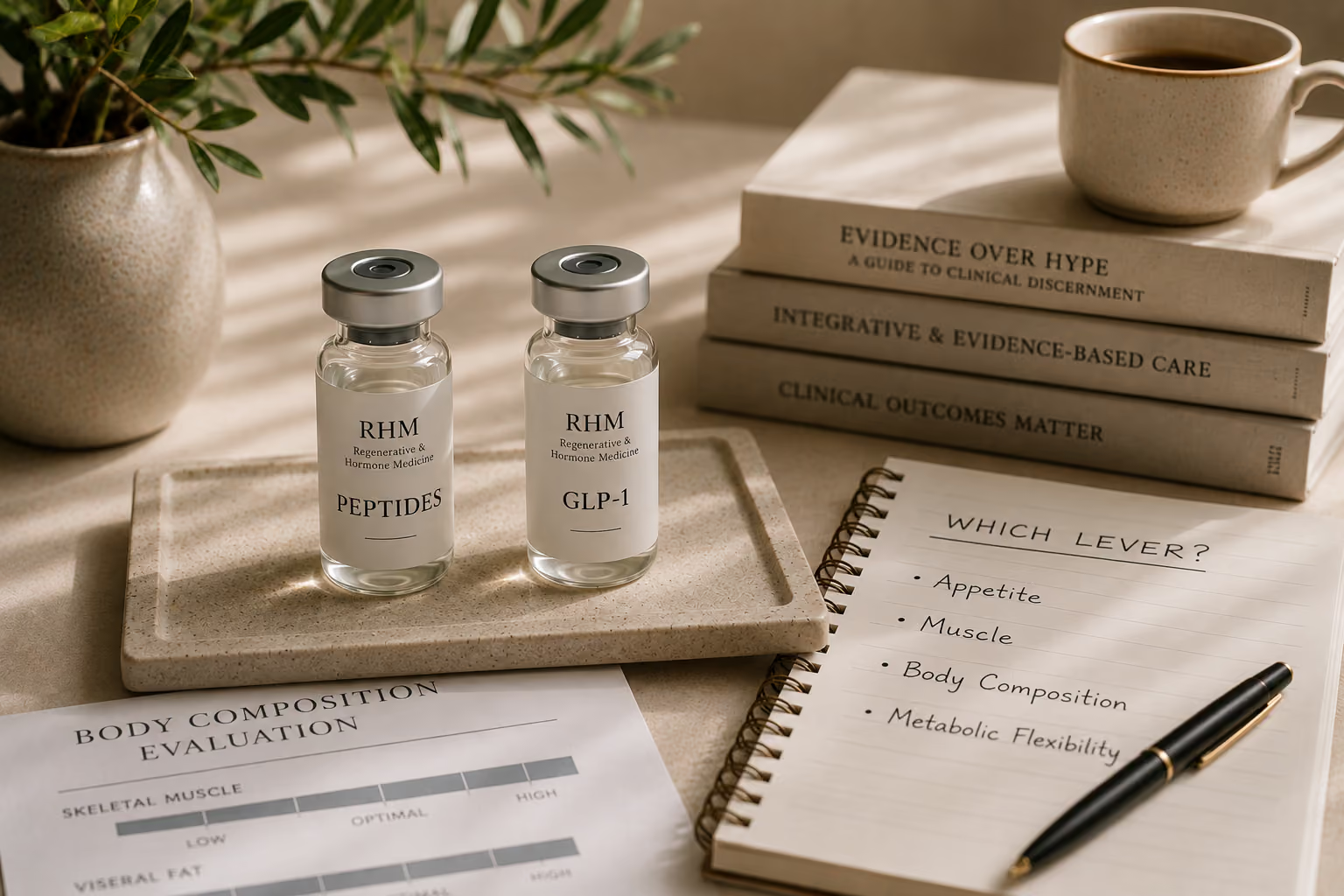
Some peptides genuinely help with weight loss, and some are mostly false advertising. The ones with strong clinical evidence and FDA approval are:
- GLP-1 medications,
- Semaglutide (Wegovy), and
- Tirzepatide (Zepbound)
They help many people lose roughly 15 to 20 percent of their body weight under medical supervision.
The other “fat-loss peptides” you see online have no such medical evidence behind them. Some examples include:
- CJC-1295,
- Ipamorelin, and
- AOD-9604
For most women, especially in midlife, the more useful question is not which peptide to buy. It is what is actually driving the weight, which is what a proper evaluation answers first.
You're doing everything right, and the scale still won't move
You are doing the things that used to work. Eating well, moving your body, staying consistent. And the scale will not move, or it is drifting in the wrong direction. The food noise has become almost constant.
Somewhere in the middle of that, you started hearing about peptides. Maybe a friend mentioned them. Maybe it was Ozempic, or a clinic promising fast results on stubborn belly fat. And underneath all of it is a fair, reasonable question: would this actually work for me, or is it one more thing that promises a lot and changes nothing?
You deserve a straight answer. Not spin, not fear. So here is the honest version, from a practice that uses these therapies carefully and also turns plenty of women away from them. Because if your body has stopped responding the way it used to, there is usually a reason, and it is rarely the one you have been blaming yourself for. Your body changed the rules. That does not mean you failed.
Do peptides actually work for weight loss?
Yes and no, and the difference matters more than almost anything else on this page.
A small number of peptides have strong clinical evidence for weight loss. A much larger number are marketed for it without that evidence. Telling one from the other is most of the work, because the marketing rarely makes that distinction for you.
So it helps to split “weight-loss peptides” into two groups: the ones with trial data and FDA approval, and the ones that sound promising but have not earned that yet.
Wait, is Ozempic a peptide?
This trips up a lot of people, so it is worth a moment.
Yes. Semaglutide and tirzepatide, the medications behind Ozempic, Wegovy, Mounjaro, and Zepbound, are peptides. They belong to a class called GLP-1 receptor agonists, and they happen to be the most studied weight-loss peptides we have. So when you read “peptides for weight loss,” the proven part of that conversation is usually these.
The confusion comes from the other direction. Most of what gets sold as “peptide therapy for fat loss” online is not a GLP-1 at all. It is a different set of compounds with a very different evidence base, which we will get to.
The peptides with real evidence: GLP-1s
GLP-1 medications work by doing something your body already does, just more steadily. They act on the signals that regulate appetite and fullness, slow how quickly your stomach empties, and help steady blood sugar. The practical effect for many people is that hunger quiets down and meals feel like enough sooner. Many women describe it less as finally having ‘willpower’ and more as finally getting relief from the constant mental noise around food, hunger, cravings, and portions.
In large clinical trials, semaglutide and tirzepatide have helped many people lose a meaningful amount of weight, often in the range of 15 to 20 percent of body weight, when paired with changes to eating and movement. Two of them, semaglutide as Wegovy and tirzepatide as Zepbound, are FDA-approved specifically for weight management.
That does not make them right for everyone. They have side effects, they ask for real medical supervision, and they work best as one part of a plan rather than the whole plan. But if the question is which peptides actually move the scale, this is the honest answer, and it is the one the evidence supports.
See whether GLP-1 therapy is actually appropriate for you.
The “fat-loss peptides” you see online, and what the evidence really shows
Now the other group. These are the peptides that fill wellness forums and clinic menus, usually promised as targeted fat burners or metabolism boosters. Some are genuinely interesting at the level of mechanism. The problem is that interesting and proven are not the same thing, and the gap between them is wide here.
Here is where the evidence actually stands, peptide by peptide.
Tesamorelin
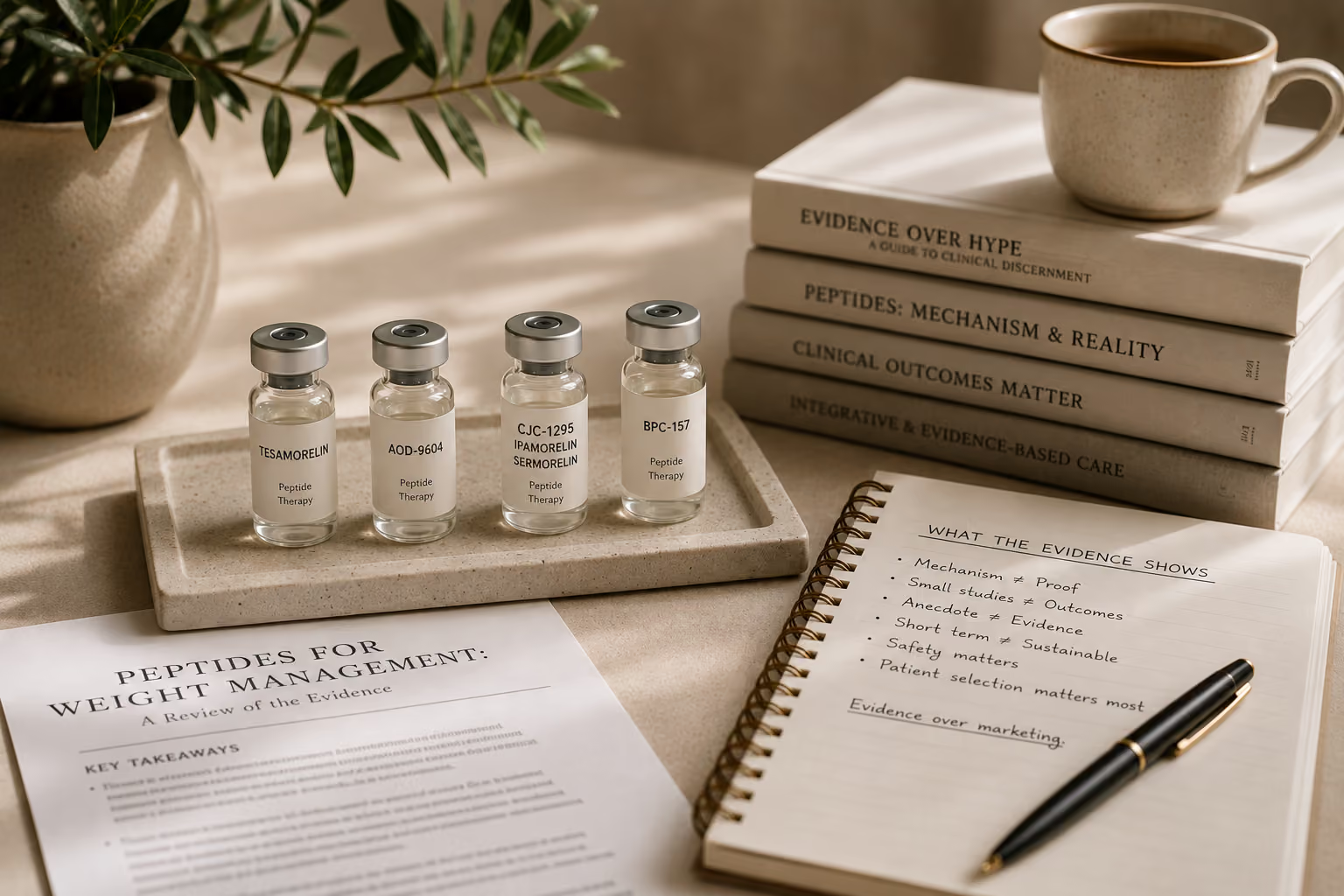
Tesamorelin is the most studied of this group, and it is FDA-approved, but only for a specific situation: reducing excess visceral fat in people with HIV-associated lipodystrophy. Its own label states it is not indicated for general weight-loss management. It may have a role for visceral fat in the right patient, but it has not been shown to be a general weight-loss treatment, and using it as one is off-label by definition.
AOD-9604
AOD-9604 is a fragment of human growth hormone marketed as a fat burner. It is plausible on paper, but it did not hold up as a weight-loss drug when it was actually tested, and it is not FDA-approved for any use. Promising in theory, unproven in practice, is a fair summary.
CJC-1295, ipamorelin, and sermorelin
These are growth-hormone-releasing peptides. They do reliably raise growth hormone and IGF-1, which is why they get described as fat-loss or body-composition peptides. What they do not have is large human trials showing they produce meaningful, lasting fat loss. They are frequently oversold, and several sit in restricted compounding territory, which we will explain in a moment.
A quick word on BPC-157 and “recovery” peptides
You will sometimes see peptides like BPC-157 pulled into fat-loss conversations. They are studied for recovery and gut health, not weight loss. They may be useful for what they are actually for, but they are not fat burners, and we will not present them as such.
The 2026 rule change you should know about before you buy anything
If you take one practical thing from this page, make it this: where your medication comes from, and who is watching over it, now matters more than ever.
For a couple of years, GLP-1 medications were in short supply, and compounding pharmacies were allowed to make their own versions to fill the gap. Those shortages have since been resolved, and that allowance has largely wound down. In 2026, the FDA proposed
excluding semaglutide, tirzepatide, and liraglutide from the 503B bulks list, which would further narrow bulk compounding of these GLP-1s. The practical effect is that broad, low-cost compounded GLP-1s are being phased out, with only narrow, patient-specific compounding remaining in limited circumstances.
Much of this shift was driven by increasing concern around compounded and counterfeit products entering the market during the shortage period. Regulators documented reports involving dosing inconsistencies, quality concerns, and products marketed as interchangeable with the approved medications despite lacking the same oversight. None of this changes the value of properly prescribed GLP-1 therapy. It simply reinforces something patients deserve to know: with these medications, sourcing, dosing, and supervision matter.
Are peptides safer than Ozempic? Honest answers on risk
It is a common assumption that a “natural” peptide from a wellness clinic must be gentler or safer than a prescription medication. In reality, safety depends far more on the quality of the product, the accuracy of the dosing, and the level of medical oversight than on how something is marketed.
The approved GLP-1 medications do have potential side effects, and they deserve to be taken seriously. Nausea, digestive changes, and appetite suppression are real, which is exactly why these therapies should be prescribed thoughtfully and monitored carefully. But they have also been extensively studied in large human trials, with known dosing standards, manufacturing oversight, and established safety data.
The larger concern with many unregulated peptides is not necessarily the molecule itself. It is the uncertainty surrounding it. When compounds are sourced outside appropriate oversight, questions arise around purity, dosing consistency, storage, and in some cases even product identity. “More natural” does not automatically mean lower risk.
A few questions come up often.
Are peptides hard on the liver?
For most patients using properly prescribed and supervised therapy, this is not typically the primary concern, though monitoring still matters and depends on the specific compound, dosing, and individual health history.
What happens when you stop?
With GLP-1 therapy in particular, appetite regulation often shifts back once treatment ends, and some weight regain can occur without a long-term plan in place. The medication can be a powerful tool, but it is most effective when combined with the broader work of improving metabolic health, muscle preservation, sleep, nutrition, and hormone balance.
Why weight resists in midlife, and why a peptide alone often isn't the fix
Here is the part most of the internet skips, and it is the part that matters most if you are a woman in your late thirties, forties, or beyond.
Weight that suddenly becomes resistant is rarely a willpower problem. More often, it is a physiology problem.
As estrogen and progesterone shift through perimenopause and menopause, other systems begin shifting alongside them. Insulin sensitivity changes. Thyroid function can drift. Cortisol becomes harder to regulate. Inflammation rises. Muscle, where much of your metabolic health lives, becomes easier to lose and harder to maintain.
None of these systems operate in isolation. When several begin changing at once, the same habits that once maintained your weight may stop producing the same result. Your body changed the rules, often quietly and gradually, long before anyone explained why.
That is not a personal failing. It is your body changing the rules without telling you.
It is also why a peptide on its own often underdelivers. If the real drivers are an underactive thyroid, poor sleep, blood-sugar swings, or muscle you have quietly been losing, adding a medication on top of all that may help a little while leaving most of the picture untouched. The medication did not fail. It was just asked to do a job that belonged to several systems at once.
This is the difference between treating a symptom and understanding what is underneath it. It is also why we start every weight conversation the same way: by actually looking deeper than the surface.
How RHM approaches weight-loss peptides
At RHM, the first question is not how to force weight loss. It is understanding what your body is actually asking for.
Before anyone talks about a peptide or a GLP-1, we look at the systems that actually regulate your weight: your hormones, your thyroid, your metabolic and insulin markers, your inflammation, your recovery. We read those results in the context of how you actually feel, not just whether each number lands inside a population range. Normal is an average. You are not an average.
From there, if a GLP-1 medication is appropriate, it is prescribed and supervised properly, with real dosing guidance, monitoring, and follow-up, and sourced through legitimate pharmacies rather than whatever is cheapest online. If other peptides have a genuine role for you, they are considered carefully and selectively, as one part of a larger plan. And if the better answer is to address your thyroid, your sleep, your muscle, or your hormones first, we will tell you that too, even when it is not the answer you came in hoping for.
That restraint is the point. The goal is not to put you on something. It is to understand what your body is actually doing, and to support it in a way that holds up over time.
“The honest question is almost never which peptide. It is what is actually driving this weight, and what does this specific body need. Get that right, and the treatment becomes obvious.”
Dr. Rand McClain

When peptides are not the right answer
Sometimes the most useful thing a physician can say is not this, or not yet.
A peptide or GLP-1 may not be the right move when the real driver is something else that has not been addressed: an underactive thyroid, chronic under-sleeping, eating far too little, or steady muscle loss that has slowed your metabolism. It may not be appropriate alongside certain health histories or during pregnancy. And it is the wrong path entirely when the only way to get it is through an unverified source with no one supervising you.
Saying no in those moments is not withholding care. It is care. The wrong tool, even a powerful one, rarely fixes the right problem.
What results look like, and how long it takes
It is fair to want to know what to expect. Here is an honest, general picture, with the reminder that bodies vary and yours is the one that matters.
With GLP-1 therapy, many people notice appetite changes within the first week or two, while meaningful changes in weight tend to unfold over roughly three to four months, not days. Patients often describe the early shift less as dramatic weight loss and more as a quieting of the constant food noise, which makes the rest of the plan easier to sustain.
What it is not is a quick fix. The people who do best treat it as support for a larger set of changes, with their physiology understood and monitored along the way, rather than as a switch that does the work for them.
What Peptides cost
Cost depends on far more than the medication itself. Responsible care includes lab work, physician oversight, dosing guidance, follow-up, and ongoing monitoring, because those are part of what make treatment both safe and effective.
It is also worth being cautious about prices that seem unusually low. Many inexpensive compounded peptides sold online come with significant questions around sourcing, quality control, dosing consistency, and medical supervision. The safest and most effective approach is one built around your physiology, your goals, and the level of support your body actually requires.
Find out what's actually driving your weight
If your body has stopped responding the way it used to, the most valuable first step is not picking a peptide. It is understanding why.
That is where we start: a physician-led evaluation of the hormone, thyroid, metabolic, and recovery patterns that shape how your body holds and releases weight. Whether the answer turns out to involve a GLP-1, another therapy, or something simpler, you will finally understand what you are working with.
Frequently asked questions
Do peptides actually work for weight loss?
Some do, and some do not. The GLP-1 peptides, semaglutide and tirzepatide, have strong evidence and FDA approval for weight loss. Most of the other peptides marketed for fat loss do not have that evidence yet, which is why the specific peptide matters so much.
Are peptides the same as Ozempic? Is semaglutide a peptide?
Semaglutide, the medication in Ozempic and Wegovy, is a peptide, and so is tirzepatide. They are the most studied weight-loss peptides we have. So when peptides and Ozempic come up in the same sentence, they are closer than most people realize.
What is the best peptide for belly fat?
There is no single best one, and any page that names one without knowing your physiology is guessing. GLP-1s have the strongest weight-loss evidence overall; tesamorelin has visceral-fat data, but only in a specific approved population. The right choice depends on what is actually driving your weight.
Are peptides safer than Ozempic?
Not automatically. An unregulated peptide from an online source is not safer simply because it sounds more natural; the bigger safety question is purity, dosing, and supervision. A properly prescribed and monitored medication is usually the safer path, not the riskier one.
Why don't some doctors prescribe these peptides?
Because most of the non-GLP-1 fat-loss peptides lack strong human evidence and FDA approval, and many sit in restricted compounding territory. Careful physicians tend to use what is proven and properly sourced, and to be honest about what is not.
What's the downside of taking peptides?
Real considerations include side effects, the need for medical supervision, ongoing cost, and the chance that weight returns if therapy stops without a maintenance plan. With unverified sources, quality and dosing become risks of their own. None of this means avoid them; it means use them thoughtfully.
What happens when you stop taking peptides?
With GLP-1s especially, appetite tends to return, and some weight can come back without a plan to maintain it. The medication supports your physiology while you take it; it does not permanently rewrite it. That is why what surrounds the medication matters as much as the medication.
How quickly do you lose weight on peptides?
With GLP-1 therapy, many people notice appetite changes in the first week or two, with more meaningful weight change over roughly three to four months. It varies from person to person, and faster is not better. Steady and supervised is.
Are compounded peptides safe?
It depends entirely on the pharmacy and the oversight. Properly sourced, patient-specific compounding under a physician can be appropriate; unverified products bought online are a real risk. Recent regulatory changes have tightened this area considerably, which is a good thing for patient safety.
How much does peptide therapy for weight loss cost?
It depends on the plan, since responsible care includes labs, provider time, and monitoring, not just the medication. Be cautious about prices that look too good to be true online. The honest way to get a real figure is a conversation built around what you actually need.

Kristin Sewnig, MSN, FNP-BC
Kristin Sewnig, MSN, FNP-BC, is a board-certified Nurse Practitioner specializing in hormone replacement therapy, menopause, thyroid health, and metabolic wellness.
With more than 25 years of clinical experience, she provides personalized, evidence-based care to help patients optimize hormones, improve quality of life, and support long-term health through preventive medicine.