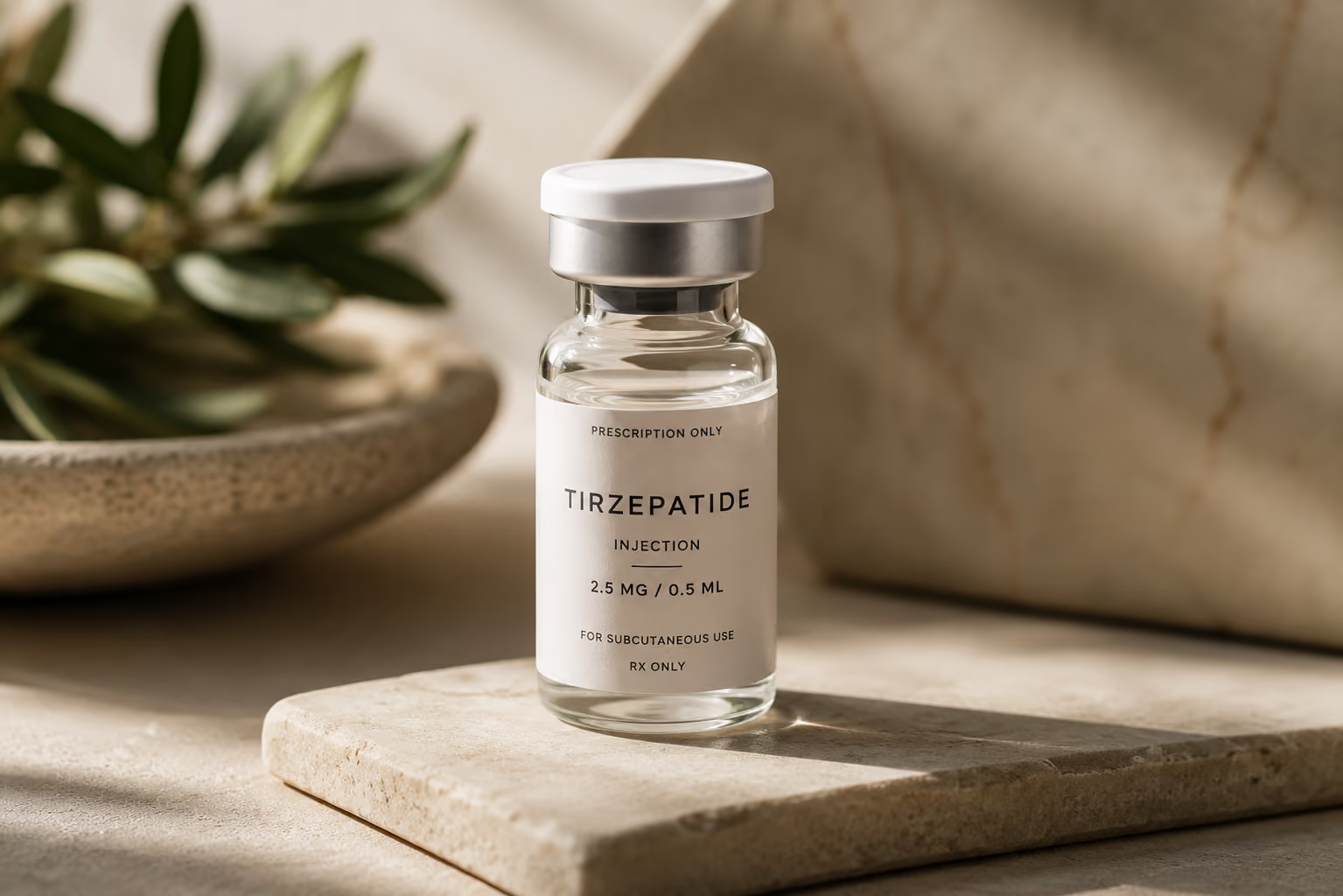
Summary
- Tirzepatide is a peptide, and a dual GIP/GLP-1 medication. It works on two metabolic signals at once, part of why it tends to be more powerful than a single GLP-1.
- The evidence is strong, and it's FDA-approved. Sold as Mounjaro and Zepbound, it has helped many people lose meaningful weight in trials — around 18 percent of body weight at the top dose, while under supervision.
- The cheap “tirzepatide peptides” online carry real risk. Mostly from uncertain sourcing, non-exact dosing, and zero supervision.
- It has real side effects and clear contraindications. Which is why it belongs in a supervised plan, and why we don't hand out a dosing chart.
- In midlife, weight usually resists for more than one reason. Hormones, thyroid, insulin, and muscle shift together, so understanding what's driving it comes first.
If it fits your physiology, tirzepatide can do real good. That starts with understanding what your body is actually doing.
Doing everything right, and the scale still won't move
You're doing the things that used to work. Eating well, moving, staying consistent. And the scale won't move, or it's drifting the wrong way no matter what you do.
Somewhere in the middle of that, you started hearing about tirzepatide. Maybe a friend lost weight on it. Maybe you saw Mounjaro or Zepbound in the news, or a clinic promising fast results, and you found yourself reading about “tirzepatide peptides” late at night, trying to work out what it even is and whether it's the same thing as Ozempic.
It's a fair question, and a confusing one, because the internet answers it in two unhelpful registers: dense pharmacology on one side, breathless before-and-after marketing on the other. So here's the version from a practice that uses these medications carefully, and also tells plenty of women they don't need them. Because if your body has stopped responding the way it used to, there's usually a reason — and it's rarely the one you've been blaming yourself for.
Is tirzepatide a peptide?
Yes. A peptide is simply a short chain of amino acids that acts as a signaling molecule — a small instruction your body uses to switch a process on or off. Tirzepatide is a synthetic peptide built to send a very specific set of those instructions; its FDA labeling describes it as a 39-amino-acid modified peptide.
So when you see it described as a “peptide,” that's accurate. It's also the least interesting thing about it, because the label tells you almost nothing about what it does. Plenty of peptides are sold for weight loss with little evidence behind them. Tirzepatide is the rare one with strong clinical data and FDA approval. What matters isn't the category. It's the specifics underneath it.
Is tirzepatide a GLP-1? The difference that actually matters
This is where most of the confusion lives, so it's worth slowing down.
You've probably heard the term GLP-1. It refers to a hormone your gut releases after you eat, one that helps regulate appetite and blood sugar. Medications like semaglutide — the active ingredient in Ozempic and Wegovy — work by acting on the GLP-1 receptor. They're GLP-1 receptor agonists, which is a technical way of saying they mimic that one signal.
Tirzepatide does that too. But it also acts on a second receptor, called GIP. That's the real distinction: tirzepatide is a dual GIP/GLP-1 receptor agonist, working on two metabolic pathways at once, where a drug like semaglutide works on one.
So is tirzepatide a GLP-1? Partly. It's a GLP-1 and a GIP medication, which is why you'll sometimes see it grouped under the GLP-1 umbrella and sometimes set apart from it. Both are true. It belongs to the same broad family, but it isn't quite the same tool — and that second signal is a big part of why it behaves the way it does, and why, on average, its effects on weight and blood sugar tend to run somewhat larger.
How tirzepatide works
What those two signals actually do is fairly intuitive once you strip the jargon away.
They quiet appetite and help you feel full sooner. They slow how quickly your stomach empties, so meals last longer. And they help steady blood sugar, which smooths out the swings that drive cravings. For many people the experience is less dramatic than they expect: not a switch that melts fat, but a quieting of the constant mental chatter about food. Hunger gets softer. A normal plate starts to feel like enough.
That quieting is what makes the rest of a plan easier to sustain. It's doing real work on your physiology, not on your willpower — which matters, because willpower was never the thing that was broken.

What the evidence actually shows
Here's where tirzepatide separates itself from most of what gets called a “weight-loss peptide.” The evidence comes from large, supervised clinical trials, and the figures are specific to the dose, the population, and the trial conditions.
In the FDA's weight-management approval, the larger trial enrolled adults without diabetes: those taking the highest approved dose — 15 mg once weekly — lost on average about 18 percent of their body weight compared with placebo over 72 weeks, alongside a reduced-calorie diet and more activity. In the trial of adults with type 2 diabetes, the average at that dose was about 12 percent. Independent reviews of the research describe a similar picture across the broader trial program.
These are trial averages under medical supervision, not a promise for any one person — what actually happens varies with the dose, your starting point, and everything else going on in your physiology. But on the strength of that evidence, tirzepatide is approved as Mounjaro for type 2 diabetes and as Zepbound for chronic weight management. Unusually for this category, if the honest question is whether it does something, the answer is yes.
None of that makes it right for everyone. It has side effects, it asks for real supervision, and it works best as one part of a plan rather than the whole plan.
Tirzepatide vs the other “weight-loss peptides” you see online
It's worth naming why this matters, because the word “peptide” gets stretched to cover a lot of things that don't belong in the same sentence.
Scroll through wellness forums and clinic menus and you'll find peptides like CJC-1295, ipamorelin, sermorelin, and AOD-9604 marketed as fat burners or metabolism boosters. Some are interesting at the level of mechanism. What they don't have is large human trials showing meaningful, lasting fat loss. They're frequently oversold, and several sit in restricted territory. We go deeper on this in our look at peptides and weight loss.
Tirzepatide is the opposite case. It's the one with the trials, the approval, and the track record. So if you've been treating all “peptides for weight loss” as roughly equivalent, this is the place to stop. Tirzepatide is in a different evidence category than most of what shares the label.
“Tirzepatide peptide” sold online — branded, compounded, and a shifting rulebook
If you take one practical thing from this page, make it this: where your tirzepatide comes from, and who is watching over it, matters as much as the medication itself.
There are really three different things being sold under the tirzepatide name, and they aren't interchangeable.
- Branded, FDA-approved medication. Mounjaro and Zepbound, made by the manufacturer, with a known dose and a known formulation.
- Patient-specific compounded tirzepatide. Prepared by a pharmacy for an individual under a prescription. There can be legitimate, narrow reasons for this, but it's a tighter, more regulated path than it used to be.
- The grey market. Vials sold cheaply online, often labelled “research use only” or “not for human consumption,” where you can't be sure of the purity, the dose, or sometimes even the identity of what's inside.
The rules here have been shifting fast. For a couple of years, tirzepatide was in short supply, and compounding pharmacies were allowed to make their own versions to fill the gap. That shortage was resolved in 2024, and the broad compounding allowance that came with it has largely wound down since. Federal scrutiny of bulk compounding has only increased: in 2026 the FDA proposed excluding tirzepatide, along with semaglutide and liraglutide, from the list of substances that large outsourcing facilities may compound in bulk — a proposal that was open for public comment as this was written, not a finalized rule. Patient-specific compounding can still happen in limited, individual circumstances, but the low-cost, mass-compounded versions that filled the shortage are being phased out.
The practical takeaway doesn't depend on the fine print. Part of what drove all this scrutiny was safety: regulators logged many reports of problems tied to compounded and counterfeit versions, a lot of them dosing errors from people drawing their own doses out of multidose vials. The source, the labeling, and the supervision are not small details. They're the safety.
Side effects, safety, and what to watch for
It's a common assumption that a peptide from a clinic must be gentler than a brand-name drug. That isn't how it works, in either direction.
The approved medication has side effects worth taking seriously. Nausea and digestive upset are the most common, which is exactly why dosing starts low and moves slowly, and why it belongs with a provider who can adjust and watch how you respond. The prescribing information also carries more serious cautions — a warning about thyroid C-cell tumors seen in animal studies, and the potential for pancreatitis and gallbladder problems — which is part of why it isn't right for everyone, and part of why supervision isn't optional.
One point that matters specifically for women: tirzepatide can make oral hormonal contraceptives less reliable around the time you start it and when the dose is increased. If that applies to you, it's worth raising with your provider, and it's the kind of detail the FDA label spells out and a careful prescriber will already be thinking about.
People also reasonably ask whether it's safe long term, whether it affects the organs, and whether it causes muscle loss. The honest answer to all three is that it depends on the person, the dose, and the monitoring — and that rapid weight loss of any kind can take some muscle with it, which is one of the reasons supervision, enough protein, and strength work matter while you're on it.
The bigger safety question with the unregulated online versions isn't the molecule at all. It's the unknown. When something is made outside proper oversight, you can't be sure what's in the vial or how much. Sounding more “natural,” or costing less, doesn't reduce that risk. It usually signals it. With any prescribed medication, side effects can also be reported through the FDA's MedWatch program.
Who tirzepatide is not for
Sometimes the most useful thing a physician can say is not you, or not yet.
Tirzepatide isn't appropriate for everyone. There are specific situations where it's avoided — a personal or family history of certain thyroid cancers (including medullary thyroid cancer or Multiple Endocrine Neoplasia syndrome type 2), pregnancy, and some gastrointestinal conditions, among others. Rather than try to screen yourself against a checklist from the internet, the safer path is a proper evaluation that looks at your full history and how your body is actually working. That isn't a formality. It's the part that keeps a powerful tool from becoming the wrong tool.
“What about a tirzepatide dosage chart?” — and why we won't hand you one
A lot of people searching for tirzepatide are really looking for a dosing schedule — how much to start with, how fast to move up, what the “standard” titration looks like.
We're not going to publish one, and the reason is the same reason this section exists. Tirzepatide is titrated individually and under supervision, because the right starting point and the right pace depend on you — your physiology, your tolerance, your history. Most of the documented harm from compounded tirzepatide traces back to exactly this: people following a generic schedule and self-dosing incorrectly from a multidose vial.
A chart can't know your body. A physician working with your labs and your response can. If you're at the point of asking about dosing, the genuinely useful next step isn't a number. It's an evaluation.
What about microdosing GLP-1s?
You may have come across the idea of microdosing GLP-1s — taking smaller amounts of a medication like tirzepatide than the standard doses used for weight loss. It's caught on with people who aren't carrying much extra weight, usually framed around gentler side effects, preserving facial fullness and muscle, fitness, or general “longevity,” rather than dramatic weight loss.
For some patients, a lower, individualized dose genuinely is the right one. But most of what gets claimed for microdosing as a trend — the anti-aging benefits, the facial-volume preservation, the sense that less is automatically safer — is still anecdotal rather than settled science. And “micro” doesn't make it casual: a small dose drawn from an unverified online vial carries the same sourcing risks as any other, sometimes more, because measuring tiny amounts by hand is exactly where errors creep in.
So we treat microdosing the way we treat every dose. The right amount of tirzepatide — larger, smaller, or none — is the one your physiology and your goals point to, decided with a physician and adjusted over time. A conservative dose can be exactly right. It just isn't something to improvise.
Why weight resists in midlife — and why a peptide alone often isn't the fix
Here's the part most of the internet skips, and it's the part that matters most if you're a woman in your late thirties, forties, or beyond.
Weight that suddenly resists is rarely a willpower problem. It's usually a physiology problem. As estrogen and progesterone shift through perimenopause and menopause, a chain of other systems shifts with them. Insulin sensitivity changes. The thyroid can drift. Cortisol gets harder to regulate. Inflammation rises. Muscle, where a lot of your metabolism lives, becomes easier to lose and harder to hold. None of these work in isolation. When several move at once, the same effort stops producing the same result.
That's not a personal failing. It's your body changing the rules without telling you.
It's also why a peptide on its own often underdelivers. If the real drivers are an underactive thyroid, blood-sugar swings, poor sleep, or muscle you've quietly been losing, adding even a powerful medication on top of all that may help a little while leaving most of the picture untouched. The medication didn't fail. It was asked to do a job that belonged to several systems at once.
This is the difference between treating a symptom and understanding what's underneath it. It's also why we start every weight conversation the same way: by actually looking.
How RHM approaches tirzepatide
At RHM, tirzepatide is not where we start. Understanding is. It sits inside our broader approach to peptide therapy, which begins with evaluation rather than a prescription.
Before anyone talks about a medication, we look at the systems that actually regulate your weight: your hormones, your thyroid, your metabolic and insulin markers, your inflammation, your recovery. We read those results in the context of how you actually feel, not just whether each number lands inside a population range. Normal is an average. You are not an average.
From there, if tirzepatide is appropriate, it's prescribed and supervised properly — with real dosing guidance, monitoring, and follow-up, and sourced through legitimate pharmacies rather than whatever is cheapest online. And if the better answer is to address your thyroid, your sleep, your muscle, or your hormones first, we'll tell you that too, even when it isn't the answer you came in hoping for.
That restraint is the point. The goal isn't to put you on something. It's to understand what your body is actually doing, and to support it in a way that holds up over time.
Dr. Rand Insight
“Tirzepatide is one of the most effective tools we have — and it still isn't the right first question. The right question is what's actually driving this weight, in this body. Answer that, and whether tirzepatide belongs in the plan becomes obvious.”
Dr. Rand McClain

What results look like, and how long it takes
It's fair to want to know what to expect, with the reminder that bodies vary and yours is the one that matters.
Many people notice appetite changes within the first week or two — that softening of food noise — while meaningful changes in weight tend to unfold over months rather than days. Patients often describe the early shift less as dramatic weight loss and more as finally feeling like a normal meal is enough, which is what makes the rest of the plan easier to keep.
What it isn't is a quick fix. The people who do best treat it as support for a larger set of changes, with their physiology understood and monitored along the way, rather than as a switch that does the work for them.
What it costs
Cost depends on more than the medication itself. A responsible plan usually includes lab work, provider time, and ongoing monitoring, and those aren't extras — they're part of what makes it safe and part of what makes it work.
It's worth being cautious about prices that look too good. Suspiciously cheap tirzepatide bought online without supervision is often cheap for the reasons covered above, and the low-cost compounded route is being phased out regardless. The honest way to get a real number for your situation is a conversation, where the plan is built around what you actually need.
Find out whether tirzepatide fits your physiology
If your body has stopped responding the way it used to, the most valuable first step isn't picking a peptide. It's understanding why.
That's where we start: a physician-led evaluation of the hormone, thyroid, metabolic, and recovery patterns that shape how your body holds and releases weight. Whether the answer turns out to involve tirzepatide, another therapy, or something simpler, you'll finally understand what you're working with.
Frequently asked questions
Is tirzepatide a peptide?
Yes. Tirzepatide is a synthetic peptide — its FDA labeling describes it as a 39-amino-acid modified peptide — and specifically a dual GIP/GLP-1 receptor agonist. The “peptide” label is accurate, but it's really just the starting point for understanding what it does.
Is tirzepatide a GLP-1? Is GLP-1 the same as tirzepatide?
Not quite the same. Tirzepatide acts on the GLP-1 receptor and the GIP receptor, so it's a dual agonist rather than a GLP-1-only medication. That's the key difference from a drug like semaglutide, which targets GLP-1 alone.
What's the difference between tirzepatide and a GLP-1 like Ozempic?
Ozempic (semaglutide) is a single-receptor GLP-1 medication; tirzepatide adds a second target, GIP. In trials, that dual action tends to produce somewhat greater weight and blood-sugar effects — though the right choice still depends on your physiology and history, not on which is “strongest.”
Is tirzepatide stronger than Ozempic?
On average, tirzepatide produces more weight loss and slightly greater blood-sugar improvement in studies. But stronger isn't automatically better for a given person. Side effects, medical history, and what's actually driving your weight all matter, which is why this is a conversation with a physician rather than a ranking.
Is tirzepatide safe for long-term use?
For appropriate, properly supervised patients it's generally considered a long-term therapy, with monitoring along the way. Safety depends heavily on legitimate sourcing and physician oversight — an unverified online version is a different risk profile than a prescribed, monitored one.
Does tirzepatide cause muscle loss?
Rapid weight loss of any kind can include some loss of muscle, which is one reason supervision, adequate protein, and strength activity matter. It's the kind of thing a monitored plan is designed to protect against, rather than something to manage alone.
Who should not take tirzepatide?
It isn't appropriate for everyone — for example, people with a personal or family history of certain thyroid cancers, during pregnancy, or with some other conditions. Rather than self-screen, the safe path is a proper evaluation that looks at your full history.
Are the “tirzepatide peptides” sold cheaply online safe?
Often no. Many are compounded or sold as research-grade products “not for human consumption,” where purity, dose, and even identity aren't guaranteed, and recent regulatory changes have tightened this area considerably. The safety question is less about the molecule and more about sourcing and supervision.
How quickly does tirzepatide start working?
Many people notice appetite changes within the first week or two, while meaningful changes in weight typically unfold over months. It varies from person to person, and faster isn't better — steady and supervised is.
Is there a tirzepatide dosage chart I can follow?
Dosing is individualized and titrated under medical supervision, so we don't publish a chart to follow on your own — most documented harm from online tirzepatide comes from people self-dosing incorrectly. The right starting point is an evaluation, not a number from the internet.
Can you microdose tirzepatide or GLP-1s?
Microdosing has become a popular trend, often for subtler appetite changes, fewer side effects, or aesthetic reasons like preserving facial volume. The catch is that the studied results come from the doses actually tested, and the benefits people hope for at much lower amounts are largely unproven. A lower dose can be right for a specific person, but that's an individualized medical decision, not a protocol to copy from online.

Rand McClain, DO
Rand McClain, DO, is a regenerative medicine and hormone replacement therapy specialist in Santa Monica, California.
With a background in sports medicine and osteopathic care, he focuses on helping patients address complex health concerns through evidence-based, personalized treatment. Dr. McClain is also the Co-founder and Chief Medical Officer of Live Cell Research and is passionate about patient education, nutrition, exercise, and longevity.