Summary
- What each one actually is: GLP-1s are a specific, FDA-approved medication class for appetite and blood sugar; peptides are a broader category spanning growth-hormone-related compounds and repair/recovery compounds.
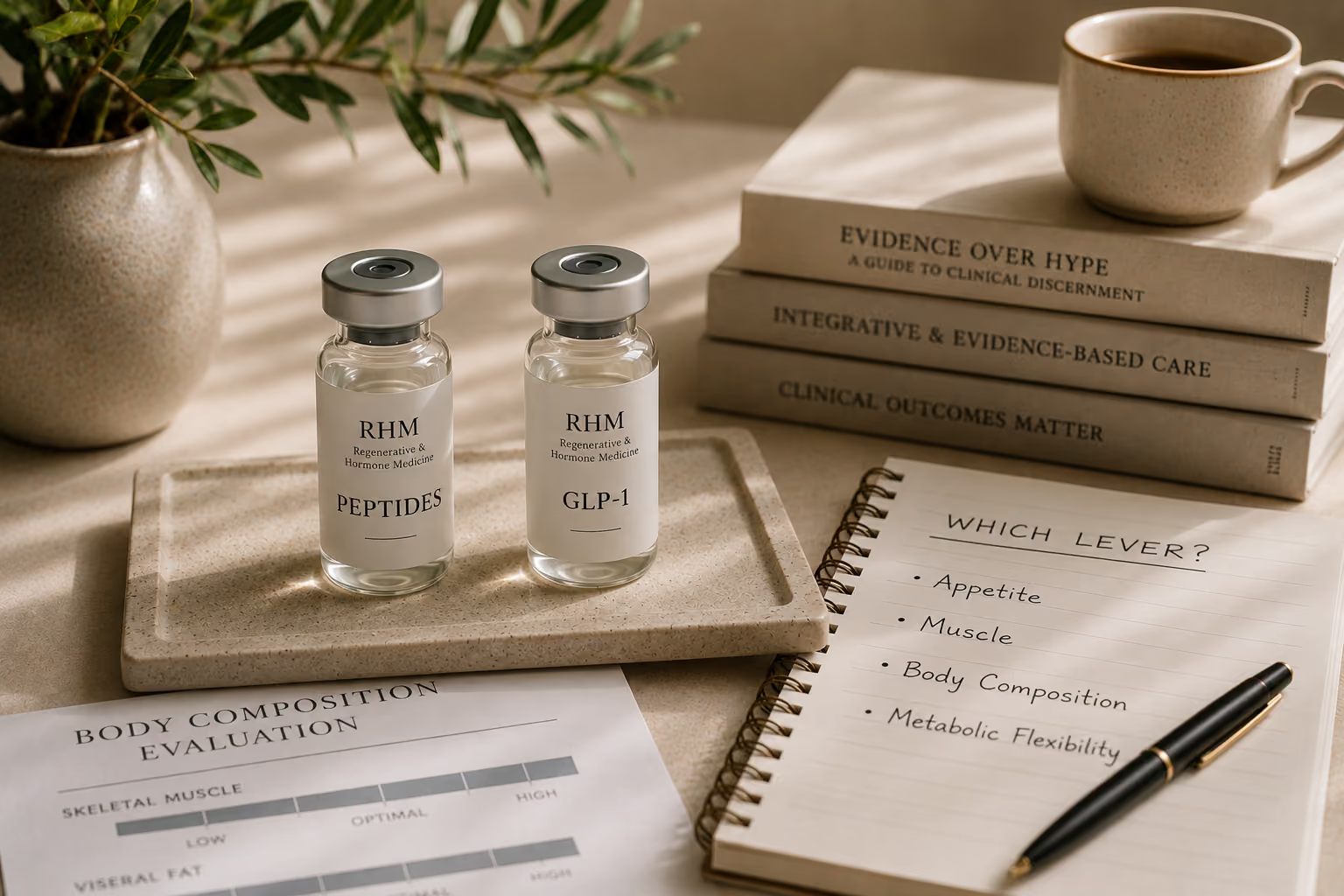
- The four things that should drive your choice: insulin resistance, muscle preservation, body composition, and metabolic flexibility — the levers that actually match your goal.
- Whether they can be combined: some patients use both, under physician supervision, based on what an evaluation shows.
- The regulatory reality: GLP-1s are FDA-approved medications; most peptides are compounded or investigational, sourced through very different quality standards.
- What to ask your physician: which lever — appetite, muscle, or metabolic flexibility — is actually the one holding your goal back.
New to peptide therapy, or looking for the broader overview? Our peptide therapy hub covers what it involves; this page focuses on how it compares to GLP-1s.
You've seen them used almost interchangeably. They're not solving the same problem.
"Peptides" and "GLP-1s" show up together constantly — in ads, on forums, in the same influencer post, sometimes in the same sentence, like two brands competing for the same job. If that's left you unsure whether they're the same thing, rivals, or something you could use together, that confusion is reasonable. The marketing around both categories rarely draws the line clearly, and plenty of vendors have a reason not to.
Here's the more useful way to think about it: GLP-1s are one specific tool, built for one job — appetite and blood sugar. Peptides are a whole category of different tools, several of which are built for entirely different jobs — muscle preservation, tissue repair, recovery. Once you know which problem you're actually trying to solve, the "which one" question gets a lot easier to answer.
The real problems people are actually trying to solve
Before either category gets a name, it helps to start with what's actually not working. Most people land on this comparison because they're dealing with one, or several, of a handful of specific problems:
Appetite and hunger that won't quiet down. Constant hunger signals, food noise, a sense that your body is working against a lower calorie intake no matter how consistent you are about it.
Muscle loss that shows up alongside weight loss. The scale moves, but so does strength and definition — a well-documented tradeoff of rapid weight loss across medication classes broadly (PMC). If this is the piece you're specifically dealing with, our article on not losing weight on a GLP-1 covers the related plateau side of this.
Metabolic inflexibility. Your body struggling to shift between burning carbs and fat efficiently — often showing up as energy crashes, sugar cravings, or a stubborn resistance to how your body used to respond to diet and exercise.
Plateaus and regain. Progress that stalls despite consistent effort, or weight that returns once a program ends — often a sign that whatever was actually driving your metabolism wasn't fully addressed in the first place.
These four problems are the real decision axis. GLP-1s and peptides are tools that answer some of them — knowing which one you're dealing with is what makes the rest of this comparison useful instead of academic.
What GLP-1s actually are
If appetite and hunger regulation is your primary problem, GLP-1 medications are built specifically for that lever. GLP-1 (glucagon-like peptide-1) is a hormone your gut releases naturally after eating, and GLP-1 medications mimic it — slowing digestion, increasing satiety, and helping regulate blood sugar. Semaglutide and tirzepatide are the two FDA-approved medications in this class, and both have a substantial base of randomized trial evidence behind them, including weight reductions in the range of 15–22% of body weight over roughly a year and a half in trial populations (NEJM). Our articles on semaglutide and tirzepatide go deeper on each medication specifically.
What GLP-1s don't do on their own is protect muscle or improve metabolic flexibility directly — those effects, where they show up, tend to be secondary to the weight loss itself. That's often where the muscle-loss problem above actually originates, and it's a real, well-studied consideration your physician monitors for.
What "peptides" actually covers
If muscle preservation, body composition, or repair and recovery are the problem you're solving, you're likely looking at a different part of the peptide category — one that has nothing to do with appetite suppression. Our peptide therapy for weight loss article covers this side of the category in more depth.
Growth-hormone secretagogues — CJC-1295, ipamorelin, sermorelin, tesamorelin — work by supporting your body's own growth-hormone signaling, which plays a role in maintaining muscle and shifting body composition. Repair and recovery peptides — BPC-157, thymosin alpha-1 — work on tissue-healing and inflammation pathways entirely separate from appetite or blood sugar.
The regulatory reality here is worth being direct about. Unlike semaglutide and tirzepatide, most of these peptides aren't FDA-approved medications. They're compounded, and compounding pharmacies can only legally prepare them from substances that meet FDA's bulk drug substance standards — a standard that shifts over time as the FDA reviews new safety data. Sourcing and physician supervision matter here as much as the peptide itself.
The four things that actually decide it
Set the drug names aside for a moment. The real decision comes down to four levers, and which one (or ones) your goal actually needs:
Insulin resistance. If your cells are responding poorly to insulin, a GLP-1 addresses this indirectly through weight loss and blood sugar regulation; some peptides support it more directly through metabolic signaling. Our weight-loss resistance page goes deeper on this specific driver.
Muscle preservation. This is where peptides built around growth-hormone support earn their place — a capability worth protecting in its own right, whether or not you're also on a GLP-1. This matters whether you're a man or a woman working through this decision, though it's worth noting that most of the peer-reviewed weight-loss trial data to date comes from mixed-sex or general-obesity populations rather than sex-specific breakdowns.
Body composition. A related but broader lever than muscle alone — how your weight is distributed between fat and lean tissue overall. This is the outcome a lot of people actually mean when they say "toning up" or "getting leaner," rather than the number on the scale, and it's a lever growth-hormone-related peptides are built to influence directly, alongside consistent strength training.
Metabolic flexibility. How efficiently your body shifts between burning carbohydrates and burning fat as fuel sources, which shows up day-to-day as steadier energy and fewer cravings rather than the sharp swings that come with a body stuck favoring one fuel source. GLP-1s can support this as a downstream effect of weight loss and improved blood sugar; certain peptides, alongside strength training, sleep, and nutrition, influence it more directly.
For a lot of people, the answer is some combination, sequenced around which lever is doing the most damage to their goal right now — a conversation for your physician.
It's worth noticing that these four levers rarely move in isolation. Insulin resistance and metabolic inflexibility tend to travel together, since both describe how efficiently your body is handling fuel; muscle preservation and body composition are similarly linked, since one is largely how you protect the other. That overlap is exactly why a single medication or peptide picked in isolation often underperforms a plan built around which combination of levers your specific body needs.
Can you use both?
Some patients do, under physician supervision — a GLP-1 addressing appetite and blood sugar, paired with a peptide addressing muscle preservation or recovery, based on what an evaluation shows about which levers need support. Your physician builds that combination around your labs, your goals, and how you're responding to what you're already on.

The GLP-1 microdosing trend, addressed honestly
If you've spent time in weight-loss or biohacking corners of social media, you've likely seen "GLP-1 microdosing" discussed as a way to get some of the appetite benefit with fewer side effects. It's worth naming plainly: this isn't an FDA-approved dosing approach, and the evidence behind it is thin — mostly anecdotal reports rather than the trial data behind standard GLP-1 dosing. We're not going to hand you numbers or a protocol here, because there isn't a well-established one to hand you. If you're curious whether a modified approach makes sense for your situation, that's a conversation to have with your physician directly.
Dr. Rand Insight:
“Patients almost always come in asking which one to pick. The better question is which of the four levers — insulin resistance, muscle, body composition, or metabolic flexibility — is actually the one holding them back. Once we know that, the "which one" question mostly answers itself.”
Dr. Rand McClain

Cost and access, honestly
Ranges vary considerably by provider, dose, and whether a medication is compounded or brand-name, so treat these as general orientation rather than a quote. Brand-name GLP-1 medications typically run several hundred to over a thousand dollars per month without insurance coverage, though coverage varies widely by plan and indication. Compounded GLP-1s and compounded peptides both tend to run lower than brand-name medication, but pricing at that end of the market varies enormously by source and shouldn't be the deciding factor — sourcing quality matters as much as price, arguably more.
This is also where the regulatory point above belongs in a cost conversation as much as a compliance one. A lower price on a compounded peptide carries the sourcing standard behind it along with the number — where it was made, to what standard, under whose oversight. Weighing that alongside cost is part of the decision, worth the same attention as the price itself.
What we evaluate before we talk about which one
Most conversations about peptides and GLP-1s start with the drug name. Ours starts with your labs. We run a full panel across 160+ biomarkers, including insulin and glucose markers that show how your body is actually handling blood sugar, and a body-composition assessment that shows what's actually happening to your muscle and fat, beyond what the scale says.
That's what turns "which one should I pick" into "which lever does my goal actually need" — an answer your evaluation gives you.
What this can look like
Appetite that finally feels manageable instead of a daily fight. Muscle and strength that hold steady through a weight-loss phase instead of quietly disappearing alongside it. Energy that doesn't crash by mid-afternoon. For a lot of patients, it's less about hitting one number on a scale and more about protecting what they're building while they get there.
None of this happens overnight, and results vary by individual — but a plan built around what your body actually needs, rather than which option is trending, is what tends to hold.
Why RHM
We're physician-led, and our peptide sourcing is LegitScript-approved — a meaningfully different standard than the grey-market vendors and compounding shortcuts that fill most of the peptide conversation online. Dr. Rand and our team build your plan around your evaluation: your labs, your goals, what's actually driving your specific case.
That starts with the same evaluation described above — insulin and glucose markers, body composition, the full biomarker panel — and ends with a plan built around which lever your specific goal needs, whether that's a GLP-1, a peptide, both, or neither.
FAQs
Are GLP-1 medications considered peptides?
Technically, yes — GLP-1 itself is a peptide hormone, and GLP-1 medications are peptide-based drugs. In practice, "peptides" as a category usually refers to the broader group of growth-hormone-related and repair compounds distinct from the FDA-approved GLP-1 medication class, which is how the terms tend to get used in everyday conversation, and how we've used them throughout this page.
What's the real difference between peptides and GLP-1 medications?
GLP-1 medications are a specific, FDA-approved class built around appetite and blood sugar. "Peptides" is a much broader category, including growth-hormone secretagogues and repair peptides that work on entirely different levers — muscle, tissue repair, recovery.
Can you take peptides and a GLP-1 medication together?
Some patients do, under physician supervision, depending on what their evaluation shows about which levers need support. This isn't something to combine on your own — it's a decision made with your physician based on your labs and goals.
Do GLP-1 medications cause muscle loss, and can peptides help protect against it?
Weight loss from any source, including GLP-1 medications, typically involves some loss of lean tissue alongside fat, though research suggests the proportion of muscle loss is generally modest relative to fat loss. Peptides that support growth-hormone signaling may help protect muscle during a weight-loss phase, and this is best evaluated and monitored with your physician.
Are peptide therapies FDA-approved?
Most are not. The FDA-approved medications in this space are the GLP-1s (semaglutide, tirzepatide). Most other peptides — including commonly discussed ones like BPC-157 and CJC-1295 — are compounded or investigational, which makes sourcing and physician oversight especially important.
How much does peptide therapy cost compared to GLP-1 medications?
Costs vary widely by provider, dose, and whether a medication is brand-name or compounded. Brand-name GLP-1s tend to run higher without insurance coverage; compounded options in both categories tend to run lower, though price shouldn't be the only factor weighed against sourcing quality.
Which one is right for me?
It depends on which lever — insulin resistance, muscle preservation, body composition, or metabolic flexibility — is actually driving your specific goal, best answered through an evaluation rather than a general comparison.
Is GLP-1 microdosing a real, safe option?
It's a trend without an established evidence base or FDA-approved dosing behind it. If you're considering a modified approach, that's a conversation to have directly with your physician rather than something to piece together informally.
Ready to find out which lever your goal actually needs?
Book a VIP call with our team. We'll walk through your goals, your labs (or which ones we'd start with), and build a plan around what your body actually needs — GLP-1, peptide, both, or neither.

Kristin Sewnig, MSN, FNP-BC
Kristin Sewnig, MSN, FNP-BC, is a board-certified Nurse Practitioner specializing in hormone replacement therapy, menopause, thyroid health, and metabolic wellness.
With more than 25 years of clinical experience, she provides personalized, evidence-based care to help patients optimize hormones, improve quality of life, and support long-term health through preventive medicine.