
Summary
- PCOS belly fat is insulin-driven. High insulin levels push fat toward your midsection and make it harder to release from there than from anywhere else on your body.
- Thyroid function is an under-discussed piece of this. Even mild, subclinical thyroid dysfunction is markedly more common in PCOS and can add fluid retention and a slower metabolic rate on top of the insulin picture.
- Inflammation and cortisol can compound it further. Both interact with insulin and androgens to make the pattern more stubborn.
- Your specific PCOS pattern matters. Insulin-resistant, inflammatory, adrenal/cortisol-driven, and lean-PCOS presentations tend to show up in the belly differently.
- A full hormone and metabolic panel — not just a scale number — is what shows which of these is driving yours, and what's worth doing about it.
It Shows Up in One Place, No Matter What You Do
You've probably noticed the pattern before you had a name for it. Your weight overall didn't move much, but your midsection changed shape.
Or you lost weight everywhere else — your face, your arms, your legs — and your stomach barely responded. You've tried cutting portions, adding cardio, cutting carbs entirely, and the rest of your body answers a little, while your stomach holds its ground.
Maybe it happened gradually, alongside irregular cycles or skin changes you were already dealing with. Maybe it showed up faster than that, in a way that felt disconnected from anything you'd changed.
Either way, you've likely been handed the same generic advice everyone gets — eat less, move more, be patient — and followed it as closely as anyone could, only to watch your midsection respond on its own timeline, or not at all.
That gap between effort and result takes a toll that has nothing to do with the number on the scale. It's the clothes you've stopped buying in certain cuts.
The photos you angle differently, or skip being in altogether. The quiet calculation before a pool day, a fitted dress, or someone's hands landing on your stomach. You're not imagining that the effort doesn't show — you're carrying something that takes real work to manage and rarely gets any credit, which makes it a lonelier kind of frustration than most people realize.
This is what it looks like when insulin is setting the rules for where your body stores fat, instead of your effort level. No amount of willpower changes the rules a hormone is playing by. This is physiology, not personal failure — common enough in PCOS that it has its own shorthand among the women who live with it: "PCOS belly."
What Makes PCOS Belly Fat Different
Most weight gain distributes fairly evenly — hips, thighs, midsection, arms.
PCOS belly fat tends to concentrate specifically as visceral fat, the kind that sits around and between your abdominal organs, rather than as the subcutaneous fat (the kind just under the skin) that shows up elsewhere on your body. That's often described as an "apple" pattern rather than a "pear" pattern, and it's one reason the same number on the scale can look and feel completely different on two different women.
The driver most researchers point to first is insulin resistance, which the majority of women with PCOS have to some degree, regardless of their weight. When your cells resist insulin's signal, your body compensates by producing more of it — and elevated insulin does two things that work against you at once: it pushes your ovaries to produce more androgens, and it signals your body to store fat preferentially in visceral tissue.
Research on body composition in PCOS has found visceral fat mass to be closely tied to whole-body insulin resistance, more so than weight alone. That's part of why "eat less, move more" so often stalls out at the waistline specifically — it's addressing calories when a hormonal signal is doing a lot of the driving. If you want the deeper mechanics of how insulin resistance affects weight more broadly, we've written about that here.
It's Not Just Insulin Resistance
Insulin resistance is usually the loudest driver, but it's rarely the only one — and the piece that gets skipped most often in PCOS content is thyroid function.
Thyroid overlap is more common than most women are told. Subclinical hypothyroidism — a mild, easy-to-miss thyroid slowdown that doesn't always show up on a standard panel — is nearly three times more common in women with PCOS than in women without it.
Thyroid hormone regulates your metabolic rate and fluid balance directly, so even a mild dip can layer a slower metabolism and more fluid retention around your midsection on top of whatever insulin resistance is already doing. Most women are never screened for this specifically in the context of PCOS weight patterns, which is one reason we screen for it directly — see our thyroid page for how we evaluate this on its own.
Androgens are another piece that often gets folded entirely into the insulin story, when the evidence points to them acting on their own too. PCOS's hallmark hormone shift — elevated androgens — appears to reshape fat distribution by acting directly on fat tissue, not just by way of insulin resistance.
Androgen receptors sit on fat cells themselves, and researchers reviewing this mechanism have found fat cells in women with PCOS run measurably larger than in BMI-matched women without it, with cell size tracking androgen levels — a separate pathway working alongside insulin resistance, not just downstream of it.
Inflammation adds to the cycle. PCOS is associated with chronic low-grade inflammation, and inflammation, insulin resistance, and androgen levels interact in a self-reinforcing loop rather than acting independently. Elevated cortisol — your body's stress hormone — can layer in as well, and tends to favor fat storage higher in the abdomen, just under the ribs.
These drivers don't show up identically in every woman, which is why it's useful to think in terms of a pattern rather than a single mechanism.
- An insulin-resistant pattern tends to concentrate fat centrally and responds slowly to diet changes alone.
- An inflammatory pattern often comes with a puffier, less defined midsection alongside skin changes, joint discomfort, or fatigue.
- An adrenal or cortisol-driven pattern tends to sit higher, under the ribs, and travels with disrupted sleep and stress-driven cravings.
- And a lean-PCOS pattern shows a disproportionate midsection on a body that looks otherwise average-weight — often the hardest of the four to get taken seriously, because the scale doesn't reflect what's happening underneath it.
None of these are fixed categories carved in stone, and most women recognize themselves in more than one — but naming the pattern is what makes the next step specific instead of generic.
What Actually Helps
Because this fat is hormonally driven, the interventions that move it look a little different from generic weight-loss advice — and the goal is body composition and metabolic function, not the scale number alone.
Nutrition built around protein, fiber, and lower-glycemic carbohydrates tends to help more than restriction does, because it works with insulin sensitivity rather than around it. Elimination diets aren't necessary and can backfire by adding stress on top of an already stressed system.
Strength training is worth calling out specifically here, separate from cardio, because building muscle improves how your body uses insulin and shifts body composition in a way that steady-state cardio alone often doesn't — this is about metabolic function, not just calories burned.
Sleep and stress management matter more than they get credit for, given cortisol's role above. None of this is a fixed protocol, and what helps most depends on which pattern is driving your particular case — which is the piece a lab panel, not a diet quiz, actually answers. For the fuller how-to plan — nutrition specifics, exercise structure, and medication options in more depth — we've laid that out in our complete guide to PCOS weight loss.
Dr. Rand Insight:
"I've had patients come in convinced their belly fat meant they weren't trying hard enough. Almost every time, their labs told a different story — usually insulin, sometimes thyroid, occasionally both at once. Once we know which one it is, the plan stops being a guess."
Dr. Rand McClain

Where Medication and Supplements Fit
For some women, especially where insulin resistance is significant, medications like metformin are sometimes used to improve insulin sensitivity, and supplements in the inositol family are commonly discussed in PCOS management for the same reason. GLP-1 medications may also come up as part of a broader plan where weight and metabolic markers warrant it.
Early PCOS-specific data is starting to back that up — a small 16-week trial combining tirzepatide with metformin found visceral fat dropped roughly seven times more than with metformin alone, with menstrual cycles resuming more often too. It's a short trial in a few dozen women, not evidence that settles what's right for every case.
None of these are a starting point on their own, and none should be started, stopped, or adjusted without your physician — what's appropriate depends entirely on what your labs actually show, and outcomes vary from woman to woman.
What We Evaluate
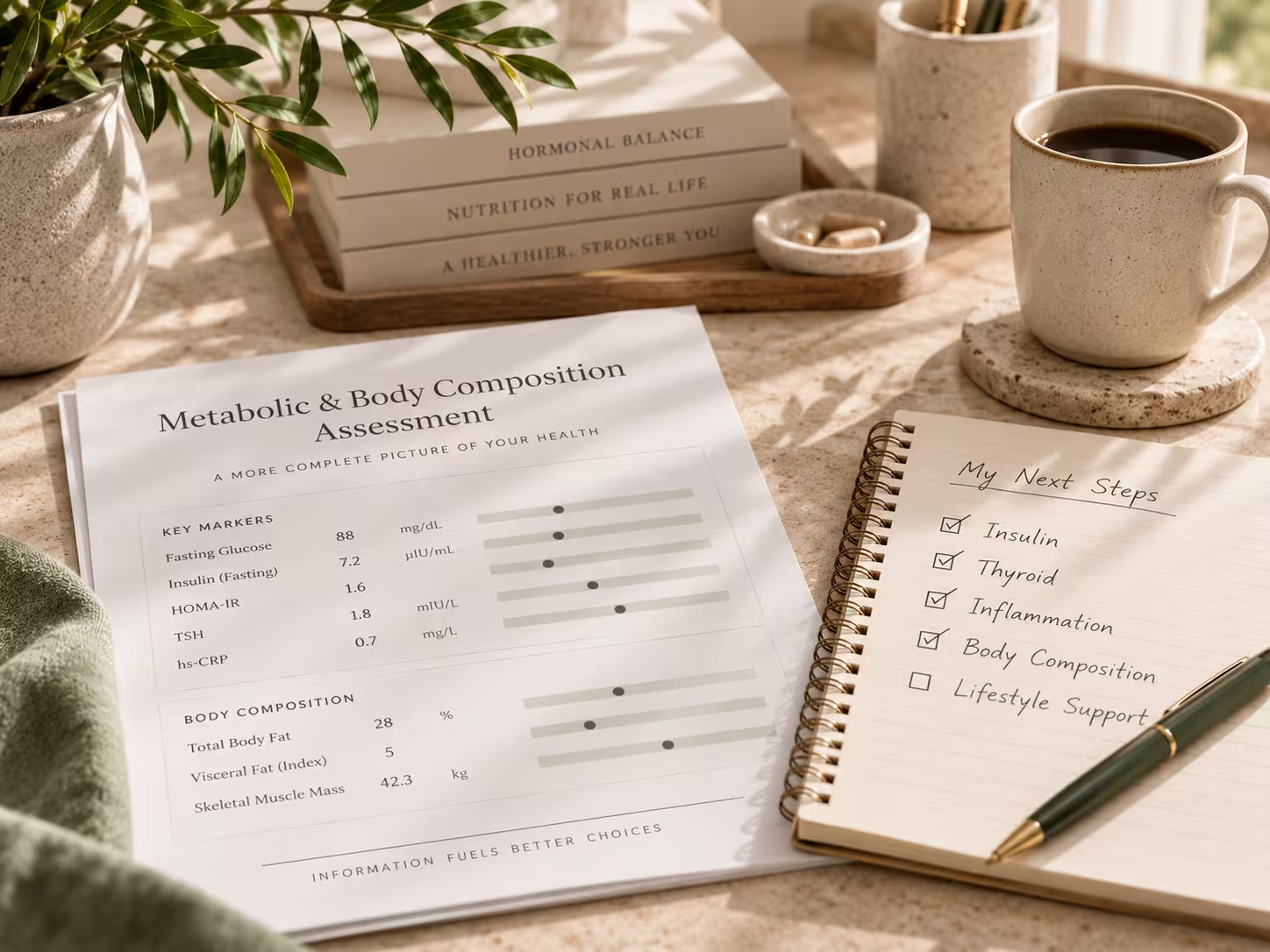
Before we talk about what might help, we look at what's actually happening in your body. That typically includes a full hormone panel, insulin and glucose markers (not just a fasting glucose check), a thyroid panel that goes beyond a standard TSH alone, and inflammatory markers, alongside a body-composition assessment that looks at where and how fat is distributed — not just your weight.
The goal is to see where you sit not just against a "normal" reference range, but against what's optimal for you specifically. In range and optimal aren't always the same thing, and that gap is often exactly where PCOS belly fat lives.

What This Can Look Like
Many women find that once the actual driver is identified — whether that's insulin resistance, thyroid function, inflammation, or some combination — the plan finally makes sense in a way generic advice never did.
That often means visible change in the midsection specifically, alongside improvements in energy, cycle regularity, or skin, over a matter of months rather than weeks. Some women describe it as the first time their effort and their results finally matched up — not because they worked harder than before, but because the plan was finally aimed at what was actually driving things.
We can't promise a specific outcome or timeline, because your physiology is specific to you, and restraint matters here too — not every woman needs medication, and not every plan looks the same. But a clearer picture usually means a plan that actually has a chance of working, instead of another round of the same advice you've already tried.
Why RHM
We're not a supplement funnel or a five-minute telehealth script that hands you the same protocol as everyone else. RHM is physician-led, and every plan starts with your actual labs, not a questionnaire.
Built around you, not a template — because "PCOS" describes a pattern, not a single condition, and your version of it deserves to be treated that way. If you want the fuller picture of how we approach PCOS more broadly, our PCOS care page covers how we evaluate and support the condition beyond weight alone, including how it connects to the weight loss resistance many women with PCOS experience.
FAQs
What does PCOS belly actually look like?
It's often described as an "apple" shape — fat concentrated centrally around the midsection rather than spread evenly across the hips and thighs. It can show up even in women whose overall weight hasn't changed much, and it often feels firmer or more centrally distributed than typical weight gain.
Why is PCOS belly fat so hard to lose compared to other weight?
Because it's largely driven by insulin resistance and, for many women, thyroid, androgen, or inflammatory factors — not just calorie balance. Diet and exercise changes that work elsewhere on the body often move more slowly here, since they're not addressing the hormonal signal directly.
Does PCOS belly go away with weight loss?
It can improve for many women, particularly when the underlying driver (insulin resistance, thyroid function, or inflammation) is addressed alongside general weight loss. It doesn't always resolve at the same pace as weight loss elsewhere on the body, and results vary depending on your specific pattern.
What's the difference between PCOS belly fat and normal abdominal fat?
PCOS belly fat tends to be more visceral (around the organs) and insulin-driven, while typical abdominal weight gain is more often a function of overall caloric surplus. The distinction matters because it points to different interventions — hormonal and metabolic support versus general calorie management alone.
Can you have "PCOS belly" without being overweight overall?
Yes. This is sometimes called lean-PCOS, where overall weight is average but the midsection is disproportionately affected. It can be one of the harder presentations to get taken seriously, since a normal weight and normal-looking labs on a standard panel don't rule out an underlying pattern.
What foods help reduce PCOS-related belly fat?
Diets built around protein, fiber, and lower-glycemic carbohydrates tend to support insulin sensitivity better than restrictive or elimination diets. There's no single food or plan that works identically for every woman with PCOS — what helps most depends on which driver is most active in your case.
Does metformin or a GLP-1 medication help with PCOS belly fat specifically?
Metformin is sometimes used to improve insulin sensitivity in women with PCOS, and GLP-1 medications may be considered as part of a broader metabolic plan in some cases. Neither is a first step on its own, and whether either is appropriate depends on your labs and history — always a conversation with your physician, not a starting assumption.
Find Out What's Actually Driving Yours
You don't have to keep guessing at a version of "eat less, move more" that was never built for your physiology — or spend another season managing your body instead of understanding it. A full hormone and metabolic evaluation can show whether insulin resistance, thyroid function, inflammation, or some combination is behind what you're seeing, and what's actually worth doing about it.
You don't need one more chart telling you your labs are "normal" — you need to know what's true for your body specifically. Book a VIP call with RHM and start with your own labs, not someone else's protocol.

Kristin Sewnig, MSN, FNP-BC
Kristin Sewnig, MSN, FNP-BC, is a board-certified Nurse Practitioner specializing in hormone replacement therapy, menopause, thyroid health, and metabolic wellness.
With more than 25 years of clinical experience, she provides personalized, evidence-based care to help patients optimize hormones, improve quality of life, and support long-term health through preventive medicine.